
7. Analyzing Uncertainty Stack-up
Overview
The uncertainty stack-up analysis is an optional step in the Morpheus™ processing pipeline. This step is recommended to ensure that the measurement data is accurate and repeatable, and the total test uncertainty is well understood in the results. The uncertainty stack-up analysis is performed by calculating test sensitivity to various error sources and then calculating the final test uncertainty arising from those error sources as defined by AOM (for the CGH fabrication process) and by you the user (for the measurement process). The final test uncertainty is then calculated by combining the individual error sources as a root-sum-square (RSS) stack-up. The final test uncertainty is then reported by Morpheus™.
Primary Sources of Uncertainty
The Uncertainty Analysis window in Morpheus™ reports the total test uncertainty, as well as the individual contributions to the test uncertainty. The Uncertainty Analysis window is shown below.
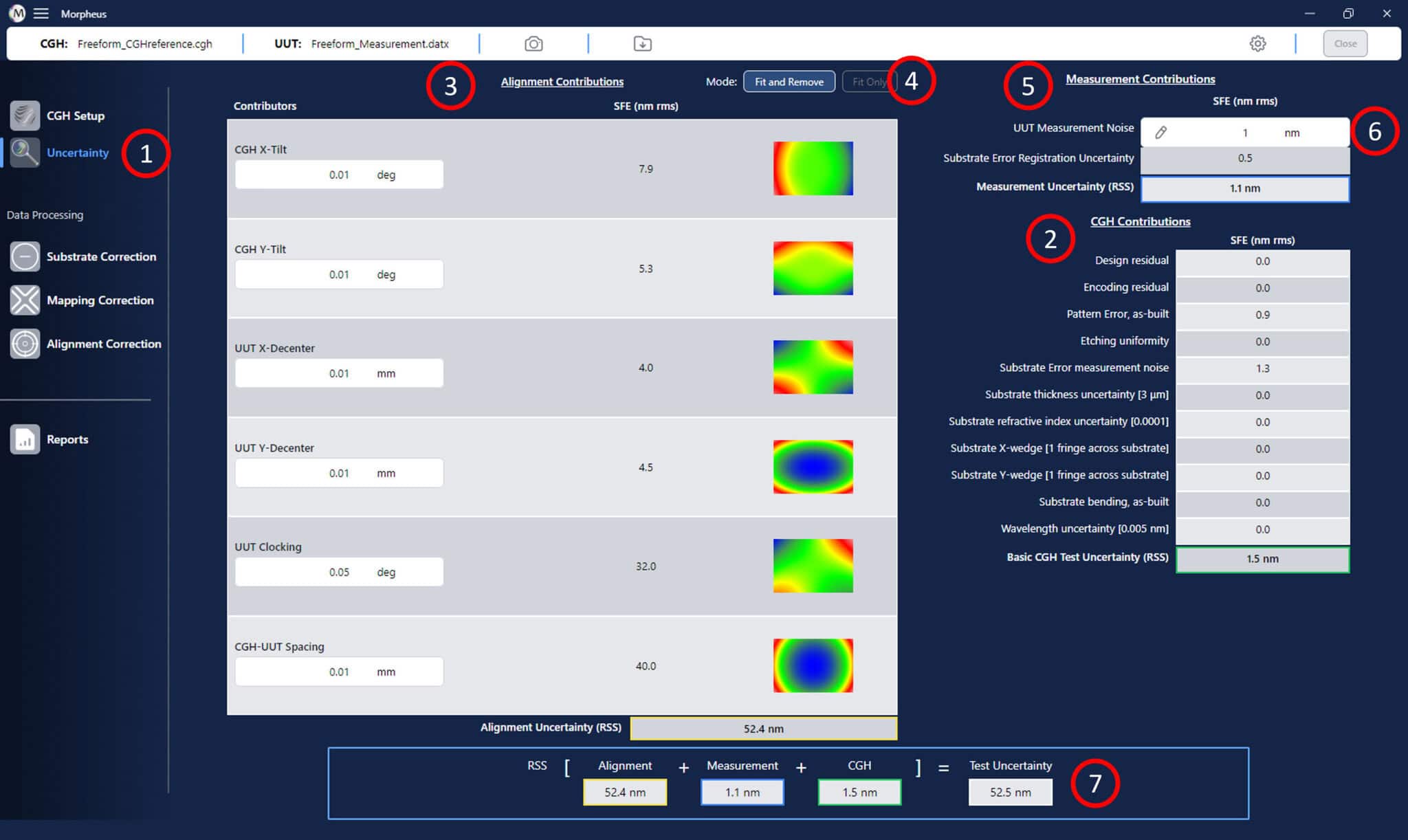
- Click on the “Uncertainty” button to view the uncertainty data.
- CGH contributions to test uncertainty are summarized in the lower right panel of the Uncertainty Analysis window. This data is provided by AOM and is contained in your .cgh file.
- Alignment contributions to the test uncertainty are summarized in the left panel of the Uncertainty Analysis window. There are two options for this uncertainty, “Fit and Remove” and “Fit Only”. These options are described in detail below, but AOM recommends using the “Fit and Remove” for most cases.
- When the misalignment modes are fit and removed in Morpheus™ during alignment correction, it assures that the uncertainty of the misalignment is at a precise value. This alignment knowledge is derived by assuming the selected fiducials in a measurement file can be aligned to the as built fiducials on the physical hologram in Morpheus™ to within 1 pixel RSS. This is reported to you the user on the substrate correction page. If that assumption is met, it leads to a positional knowledge of the UUT with correlates to a low uncertainty in the alignment of the UUT only, which is reported in the alignment contributions section when ‘Fit and Remove’ is selected. These values have been independently verified as well through tests with real optics, in which after running monte carlo trials of N>10 with the UUT at severe, random misaligned states, Morpheus™ consistently reports a final surface with a standard deviation of ~1 nm, across a range of optics and misaligned states. This is the recommended processing method and should only be changed if you are confident in understanding the processing implications of not removing misalignment modes. If you do not fit and remove the misalignment modes, the residual uncertainty becomes the accuracy to which the alignment for various degrees of freedom was controlled during the test. The values can be edited to represent your specific test configuration by clicking on the ‘Fit Only’ option and inputting your unique tolerance values. The SFE associated with each alignment degree of freedom is calculated automatically from sensitivities stored in the .cgh file.
- The measurement data contributions to the test uncertainty are summarized in the upper right panel of the Uncertainty Analysis window.
- A measurement noise value specific to your test configuration can be input by clicking the pencil icon next to the UUT Measurement Noise field. Please contact AOM for help on how to measure and define the noise and as tested alignment tolerance values for your test.
- The total test uncertainty is reported in the bottom right panel of the Uncertainty Analysis window. The total test uncertainty is calculated by combining the individual error sources as a root-sum-square (RSS) stack-up. Details on each of the individual contributions to the test uncertainty are provided below.
CGH Contributions to Test Uncertainty
The CGH has small contributions to the test uncertainty, both from the design itself as well as the fabrication process. The CGH uncertainty is evaluated by determining the surface figure error uncertainty arising from various sources, which are stacked up into a total Basic CGH Test Uncertainty (RSS) value reported in units of nm. These contributions are detailed below.
Design Residual Error
The CGH test was designed to give a nearly perfectly corrected wavefront, minimizing mapping distortion and ghosts from stray diffraction orders. There may be however a very small residual wavefront error, which contributes to the overall surface figure error.
Encoding Residual Error
The CGH is encoded with discrete sample points across the continuous pattern, which means that the CGH can only approximate the ideal wavefront. This approximation is very good, but there is a small residual error due to the finite sampling points, which is evaluated by feeding in the actual pattern design details back into the optical model and recording the offsets between the theoretical continuous pattern and the as built details and recording how that adds to the surface figure error.
Pattern Error, As-built
The CGH is fabricated using a process to transfer the designed pattern onto the physical substrate. There may be slight errors in the transfer process. To evaluate the error, the CGH design has a regular grid of microscopic fiducials embedded into the pattern. Their positions are measured by AOM after the final hologram is fabricated. The deviation of these marks’ positions from the nominal gives a good indication of how accurately the overall pattern is written. This information is then used to evaluate the pattern error and how it contributes to the surface figure error. Additionally, please note these patterns do not impact your measurement.
Etching Uniformity
The CGH is fabricated using a process to transfer the designed pattern onto the physical substrate. In some cases, this process involves etching the pattern into the substrate. AOM samples the etch depth across the as built CGH, and this is used to determine an uncertainty value for the overall etch depth uniformity. This uncertainty is then used to evaluate the surface figure error.
Substrate Error Measurement Noise
When measuring the substrate transmitted wavefront error at AOM, there is a small amount of noise in the measurement. This noise is evaluated by measuring the substrate TWE multiple times and evaluating the standard deviation of the measurements.
Substrate Thickness Uncertainty
The as-built substrate thickness is taken into account in the design of the CGH. This uncertainty value is due to the measurement uncertainty present when assessing substrate thickness. The 3-sigma value of the standard deviation is then used to evaluate the surface figure error.
Substrate Refractive Index Uncertainty
Based on the refractive index tolerance provided by AOM’s substrate vendors, an uncertainty value is provided and used to evaluate the surface figure error arising from the substrate refractive index uncertainty.
Substrate Wedge Uncertainty
The substrate may have some slight amount of wedge, in the X and or Y direction. AOM budgets an analysis of what SFE 1 fringe of wedge across the substrate, and assesses this contribution to the overall test uncertainty.
Substrate Bending, As-built
AOM measures the power of the substrate in transmission and in reflection to determine how much bending is present in the substrate. This bending is then used to evaluate how much it contributes to the overall surface figure error.
Wavelength Uncertainty
The wavelength of the laser used to measure the UUT is known to a particular uncertainty. However, wavelength can vary from location to location due to environmental aspects such as pressure, temperature, and humidity. AOM captures this as a wavelength uncertainty value and this value is used to evaluate the surface figure error the wavelength uncertainty contributes to the overall test. Note that if lower uncertainty is desired, AOM can reduce this value with knowledge of the site at which the CGH will be used.
Alignment Contribution to Test Uncertainty
The alignment of the UUT to the CGH is a source of uncertainty in the overall test. This is because the CGH is designed to be used in a specific test geometry, and any deviation from that test geometry will result in some amount of error in the measurement. The alignment uncertainty is evaluated by determining the surface figure error sensitivity to various alignment modes, which are stacked up into a total ‘Alignment Uncertainty’ RSS value reported in units of nm. Note, while AOM provides nominal alignment tolerance values, these are only valid if the misalignment modes are fit and removed. If you are not fitting and removing misalignment modes, you must input accurate tolerance values for your test configuration. These tolerance values are then used in combination with the pre-determined sensitivity values to calculate the overall surface figure error contribution to the test uncertainty. Each alignment mode is described below.
CGH X-Tilt
The CGH X-Tilt is the tilt of the CGH about the X axis of the CGH coordinate frame relative to the interferometer. AOM provides a sensitivity analysis during design of the hologram, and you as the user must report what tolerance value you used in your test in units of fringes, which is how much sensitivity in seeing a fringe across the full retro region your test setup has. Typically, visually, this can be aligned to about a quarter fringe. This tolerance value is then used in combination with the pre-determined sensitivity value to calculate the overall surface figure error contribution to the test uncertainty.
CGH Y-Tilt
The CGH Y-tilt is the tilt of the CGH about the Y axis of the CGH coordinate frame relative to the interferometer. AOM provides a sensitivity analysis during design of the hologram, and you as the user must report what tolerance value you used in your test in units of fringes, which is how much sensitivity in seeing a fringe across the full retro region your test setup has. Typically, visually, this can be aligned to about a quarter fringe. This tolerance value is then used in combination with the pre-determined sensitivity value to calculate the overall surface figure error contribution to the test uncertainty.
Int-CGH Spacing
When the CGH design calls for using a transmission sphere or diverger transmission element, this becomes a meaningful contributor to the test uncertainty (for a design using a transmission flat, the test is insensitive to this alignment uncertainty). The Int-Cgh spacing is defined as the distance along the Z axis of the CGH between the CGH origin and the focus of the interferometer beam. AOM provides a sensitivity analysis during design of the hologram, and you as the user must report what tolerance value you used in your test in units of fringes, which is how much sensitivity in seeing a fringe across the full retro region your test setup has. Typically, visually, this can be aligned to about a quarter fringe. This tolerance value is then used in combination with the pre-determined sensitivity value to calculate the overall surface figure error contribution to the test uncertainty.
UUT X-Decenter
The UUT X-decenter is the decenter of the UUT along the X axis of the UUT coordinate frame relative to the CGH origin. AOM provides a sensitivity analysis during design of the CGH, and you as the user must report what tolerance value you used in your test in units of mm. This tolerance value is then used in combination with the pre-determined sensitivity value to calculate the overall surface figure error contribution to the test uncertainty.
UUT Y-Decenter
The UUT Y-decenter is the decenter of the UUT along the Y axis of the UUT coordinate frame relative to the CGH origin. AOM provides a sensitivity analysis during design of the CGH, and you as the user must report what tolerance value you used in your test in units of mm. This tolerance value is then used in combination with the pre-determined sensitivity value to calculate the overall surface figure error contribution to the test uncertainty.
UUT Clocking
UUT clocking is the rotation of the UUT about the Z axis of the test optic coordinate frame. AOM provides a sensitivity analysis during design of the CGH, and you as the user must report what tolerance value you used in your test in units of degrees. This tolerance value is then used in combination with the pre-determined sensitivity value to calculate the overall surface figure error contribution to the test uncertainty.
CGH-UUT Spacing
The CGH-UUT spacing is the distance along the Z-axis of the test optic between the CGH origin and the vertex of the UUT. AOM provides a sensitivity analysis during design of the CGH, and you as the user must report what tolerance value you achieved in your test in units of mm. This tolerance value is then used in combination with the pre-determined sensitivity value to calculate the overall surface figure error contribution to the test uncertainty.
Measurement Contributions to Test Uncertainty
The unit under test (UUT) data contributes to the test uncertainty. The measurement of the UUT itself has sources of uncertainty which can contribute to the overall test uncertainty. These sources are stacked into a total ‘UUT Data Uncertainty’ RSS value reported in units of nm. These contributions are detailed below.
UUT Measurement Noise
The measurement of the UUT itself has some amount of noise in the measurement. While AOM provides a nominal value, the user is expected to provide the actual noise uncertainty value in units of nm RMS during the test. Please contact AOM if you have questions about this value.
Substrate Error Registration Uncertainty
The substrate error registration uncertainty is the test uncertainty that comes from the registration of the substrate error map fiducials to the UUT measurement map fiducials when the CGH substrate error is removed from the data. AOM estimates this uncertainty value based on the slope magnitude rms in the CGH substrate error map and the fiducial fit residual value from the Remove CGH Substrate Error data processing step.
Test Uncertainty Results
The CGH, Alignment, and Measurement Uncertainties are combined to determine the RSS surface figure error measurement uncertainty, in units of nm, present in the test.
Next Steps
You are now ready to proceed with generating a report of the data processing results. Please see the Generating a Report section of this manual for details on how to generate a report of the data processing results.